

Lithium (Li) and water
Lithium in water: occurrence, chemistry, health and treatment
Lithium occurs naturally in some groundwater and surface water, usually as dissolved lithium ions (Li+). Concentrations vary with local geology and water chemistry. Lithium metal reacting with water is a different situation from lithium ions already present in a water supply.
How does lithium occur in water?
Weathering of lithium-bearing minerals can release lithium into groundwater. It is also found in some saline waters and brines. Concentrations vary between aquifers and can be influenced by rock type, water–rock contact, evaporation and mixing with saline water. Mining, processing and disposal of lithium-containing products may also contribute to releases, depending on local conditions.
In natural water, lithium is generally present as the dissolved Li+ ion rather than as metallic lithium. Its movement and interactions with minerals depend on water chemistry, including salinity and the presence of other ions.
How does lithium metal react with water?
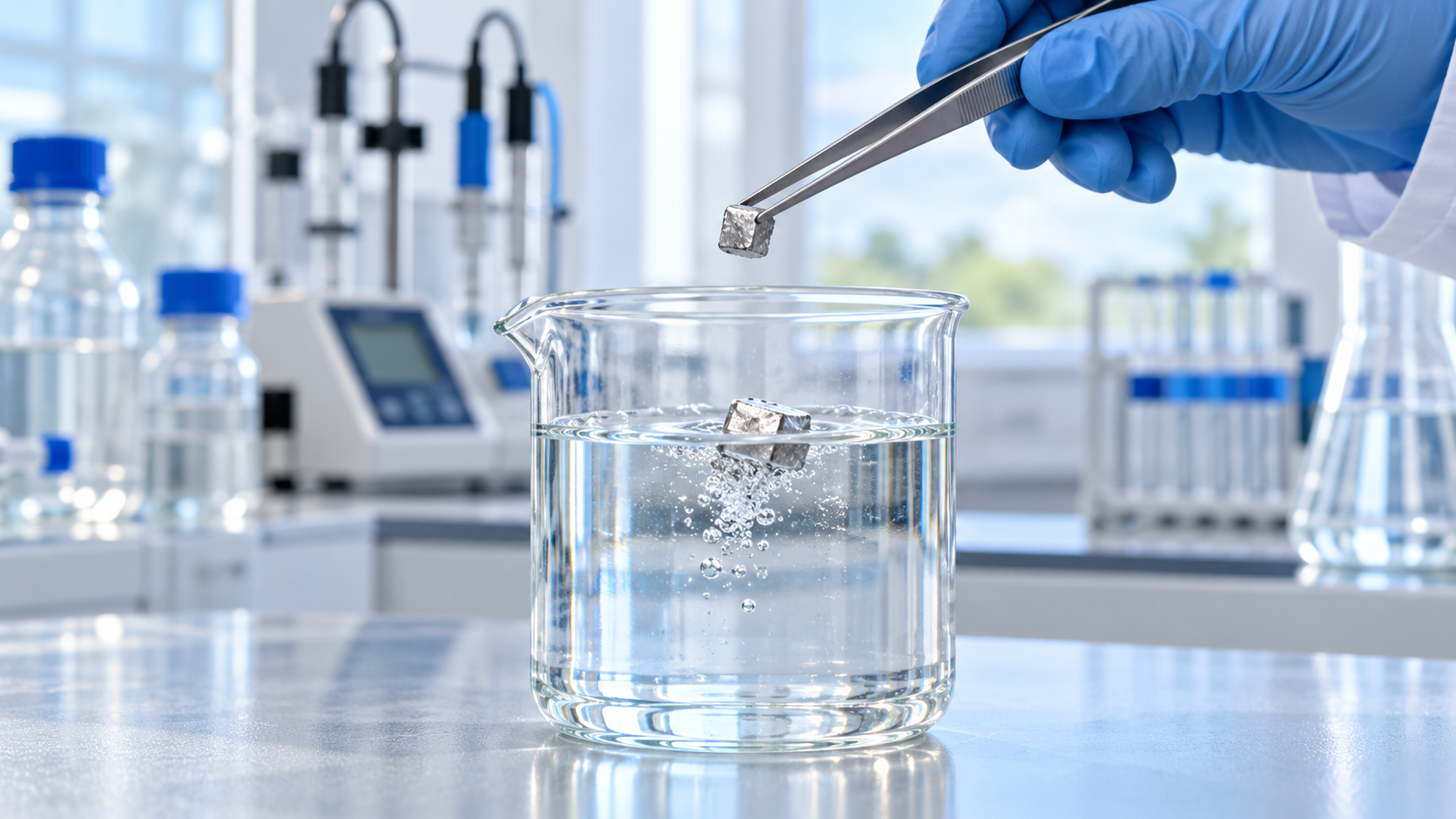
Elemental lithium metal reacts with liquid water to form lithium hydroxide and hydrogen gas:
2 Li(s) + 2 H2O(l) → 2 LiOH(aq) + H2(g)
This equation describes metallic lithium, not dissolved Li+ in groundwater, rivers or drinking water. Lithium metal is not the form normally found in natural water.
Environmental behaviour
Lithium occurs in many rocks and natural waters, but concentrations vary considerably by location. Dissolved lithium can move with groundwater and surface water; some may interact with clay minerals or sediments depending on local geochemistry. Effects on aquatic organisms and plants depend on concentration, exposure and water chemistry.
The presence of lithium in water does not by itself demonstrate a health or ecological benefit. Evidence about effects at low environmental concentrations is still developing.
Health and drinking-water monitoring
Lithium compounds are prescribed medicines for some people with bipolar disorder. Medical treatment uses doses that are not comparable to typical environmental exposure and requires clinical monitoring; adverse effects can include effects on kidney and thyroid function. Evidence about possible health effects from the much lower concentrations found in some drinking-water sources is limited and developing. Effects reported during medical treatment should not be used to predict the effects of low-level exposure from water.
The U.S. EPA has not established a federal drinking-water standard or health advisory for lithium. EPA uses a non-regulatory Health Reference Level (HRL) of 10 µg/L for screening and prioritisation; EPA states that this is not a final determination of a concentration necessary to protect a population. The 9 µg/L minimum reporting level used for EPA's Unregulated Contaminant Monitoring Rule is a laboratory reporting threshold, not a health limit. These values have different purposes and should not be interpreted as boundaries between safe and unsafe water. Requirements and guidance may differ by jurisdiction.
Which treatment technologies can reduce lithium?
Boiling, heating and disinfection do not remove lithium. Treatment performance depends on the source water, competing ions, system design and operating conditions.
- Reverse osmosis: an EPA review of pilot- and full-scale studies reported high lithium removal with reverse osmosis in the studies evaluated. Actual performance varies with the membrane, water chemistry and operating conditions; the review does not guarantee a specific result for every water source.
- Ion exchange and lime softening: these methods showed variable and inconsistent lithium removal in the studies reviewed. Do not assume a particular reduction without testing.
- Conventional filtration and common treatment media: these should not be assumed to remove dissolved lithium effectively. Verify any proposed process for the specific water and treatment goal.
Membrane treatment also produces a concentrated reject stream that requires appropriate management. Lenntech provides general information about reverse osmosis and ion exchange.
Brine chemistry and selectivity considerations in Direct Lithium Extraction
For more information about common lithium compounds, their occurrence in aqueous streams and treatment options, see common lithium salts in aqueous solutions and their removal/purification technologies.
Last reviewed: 3 November 2026 by Lenntech.
Sources and further reading
- U.S. EPA: Fifth Unregulated Contaminant Monitoring Rule (UCMR 5), including lithium monitoring information.
- U.S. EPA: Technical Fact Sheet — Lithium in Drinking Water.
- U.S. EPA: UCMR 5 Data Summary.
- U.S. Geological Survey: Lithium in groundwater used for drinking-water supply in the United States.
- U.S. EPA Science Inventory: Review of pilot- and full-scale lithium-removal studies.
Read more about elements and their interaction with water.