

Promethium - Pm
Promethium (Pm)
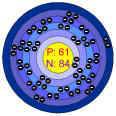
Promethium is a radioactive lanthanide with no stable isotopes. It is produced mainly by nuclear fission and is present naturally only in trace amounts because its isotopes decay. Promethium-147 is used in specialised research and radiation-source applications.
| Atomic number | 61 |
|---|---|
| Representative isotope mass number | [145] — not a standard atomic weight |
| Electron configuration | [Xe] 4f5 6s2 |
| Density | about 7.26 g/cm3 (estimated) |
| Melting point | about 1042 °C (estimated) |
| Boiling point | about 3000 °C (estimated) |
| Half-life of Pm-145 | about 17.7 years |
| Half-life of Pm-147 | about 2.62 years |
Uses and applications
Promethium-147 emits beta radiation and has been used in specialised devices and research applications, including some thickness gauges and luminous sources. Its radioactive nature requires controlled handling, suitable shielding and containment, and compliance with applicable radiation-safety requirements.
Promethium and water management
Promethium is not used in conventional water treatment. If radioactive promethium is present in a process or waste stream, its assessment and management require radiological characterisation and controls appropriate to the site and applicable regulations; ordinary dissolved-metal treatment assumptions are not sufficient.
Occurrence and environmental context
All promethium isotopes are radioactive. Its short-lived isotopes mean that only trace quantities occur naturally, while most practical quantities are produced through nuclear processes. Environmental behaviour depends on isotope, chemical form, and the surrounding water and solids.
Health and safety
Promethium presents an ionising-radiation hazard. Risk depends on isotope, activity, exposure route, and containment. Work should be performed only under qualified radiation-protection procedures.
Back to the periodic table of elements
Sources and further reading
Element page last reviewed: 24 October 2026 by Lenntech.